Ancient Civilizations
Ancient civilizations were the first large, city-based societies of the human past — communities that pooled food surpluses, invented writing and record-keeping, and built states run by kings, priests, and bureaucrats. They emerged independently in a handful of river valleys and coastal zones between roughly 3500 BCE and the first millennium BCE, and their institutions still shape how we live today.
The problem of the word
Before we can speak of "ancient civilizations" in the plural, we have to reckon with the fact that the very idea is a modern invention, and a loaded one. The English word descends from the Latin civis ("citizen") and civitas ("city"), by way of the French civilisé. As an abstract noun meaning a "civilized condition," it is astonishingly recent: it enters French around 1757 in the writings of the physiocrat Victor de Riqueti, marquis de Mirabeau, and English usually credits its first appearance to the Scottish Enlightenment thinker Adam Ferguson. In his Essay on the History of Civil Society (1767), Ferguson wrote the sentence that became a founding text for the concept:
"Not only the individual advances from infancy to manhood, but the species itself from rudeness to civilisation."
Two things about that sentence should trouble a careful reader. First, "civilisation" is set against "rudeness" and "barbarism," so the word is born already carrying a hierarchy — a ladder of progress with the speaker conveniently near the top. Second, Ferguson used the term in the singular. For the philosophers of the eighteenth century and the era of the French Revolution, "civilization" was one thing: the forward march of humanity as a whole, from savagery through barbarism to refinement. The plural — civilizations, as discrete, comparable cultural units — is a nineteenth- and especially twentieth-century development. When we casually list "the ancient civilizations" of Egypt, Mesopotamia, and China, we are using a grammar that would have puzzled the very Enlightenment thinkers who coined the word.
That grammatical shift matters because it enabled two contradictory intellectual projects. One, comparative and relativist, treated each civilization as a coherent whole worthy of study on its own terms. The other, evaluative and hierarchical, used "civilization" to justify domination. The modern Western idea of the civilized crystallized precisely in contrast to the peoples encountered during the European colonization of the Americas and Australia; the "uncivilized" other became both a foil for European identity and a pretext for conquest. British settlers in Australia argued that because Indigenous Australians had not fenced and ploughed the land in a manner Europeans recognized, they had failed to "improve" it and had thereby forfeited it. The genealogy of the word is thus inseparable from the history of empire, and any serious study of ancient civilizations has to hold that critical awareness alongside its admiration for aqueducts and epics.
A dissenting tradition ran the other way. Jean-Jacques Rousseau, especially in Emile (1762), suspected that civilization corrupted a more natural human wholeness — the germ of the "noble savage" idea. In Germany, Johann Gottfried Herder, and later Nietzsche, sharpened a distinction between Kultur (an organic, felt folk-spirit) and Zivilisation (rational, material, and somehow hollow). Norbert Elias's monumental The Civilizing Process (1939) traced how manners, self-restraint, and the management of bodily functions tightened from medieval courtly society onward — treating "civilization" not as a state you either possess or lack, but as a long, continuous disciplining of the self. These debates form the intellectual water in which the study of ancient civilizations still swims.
The Neolithic threshold and the Urban Revolution
Ancient civilizations did not spring from nothing. They rest on a slower transformation, the Neolithic Revolution: the shift from foraging to farming and settled life. The earliest evidence comes from the Levantine corridor, where the Natufian culture was harvesting — and eventually planting — cereals from around 11,000 BCE. At Göbekli Tepe in southeastern Anatolia, from roughly 9500 BCE, people who were not yet full farmers raised massive carved stone pillars in ritual enclosures, upending the old assumption that monumental architecture followed agriculture rather than possibly helping to drive it. Comparable Neolithic beginnings appear independently in the Yellow River and Yangtze basins of China (the Peiligang and Pengtoushan cultures) and, later and separately, in the Americas.
The leap from farming villages to cities and states is what the Australian-born archaeologist V. Gordon Childe famously named the Urban Revolution in the 1930s. Childe, a Marxist synthesizer of enormous range, proposed a checklist of traits that distinguished the new order: dense cities, full-time specialists freed from food production, concentration of surplus wealth, monumental public buildings, a ruling class, writing, predictive sciences like arithmetic and astronomy, sophisticated art, long-distance trade, and the state itself. His list has been endlessly criticized — it is a description masquerading as an explanation, and it fits Mesopotamia better than anywhere else — but nearly every subsequent theory of state formation is a response to Childe.
Climate played a part in tipping villages into cities. The 8.2-kiloyear cold event and the aridification around 5,900 years ago dried out semiarid regions and pushed populations together along reliable rivers, while raising the stakes of competition over scarce well-watered land. Some archaeologists read the appearance of walled towns — and the abandonment of open villages — as a signature of this new, more violent and more concentrated world.

The carved megaliths of Göbekli Tepe (from c. 9500 BCE), monumental architecture built before full agriculture — source
Mesopotamia: the first cities and the first writing
If any place has the strongest claim to "first civilization," it is southern Mesopotamia, the alluvial plain between the Tigris and Euphrates in present-day Iraq. During the Uruk period (roughly 4000–3100 BCE), the city of Uruk swelled to perhaps 40,000 or more inhabitants, ringed by a wall that later tradition credited to the hero-king Gilgamesh. Here appeared temple-centered economies, mass-produced pottery, the cylinder seal, and — decisively — writing.
Cuneiform script begins around 3400–3200 BCE not as poetry but as accountancy: wedge-shaped marks pressed into clay to record quantities of grain, beer, and livestock owed to and disbursed by temple households. Writing, in other words, was born of bureaucracy. As the standard formulation has it, writing "appears to accompany the rise of complex administrative bureaucracies or the conquest state." Only later did the same technology come to carry law, letters, hymns, and the world's oldest surviving long poem, the Epic of Gilgamesh, whose flood narrative predates and parallels the biblical one:
"Six days and seven nights the wind blew, flood and tempest overwhelmed the land … all mankind was turned to clay."
Mesopotamia also gave us codified law. The stele of Hammurabi, king of Babylon (reigned about 1792–1750 BCE), inscribes some 282 provisions around 1754 BCE, opening with the king's claim that the gods called him "to cause justice to prevail in the land, to destroy the wicked and the evil, that the strong might not oppress the weak." Its famous lex talionis — "if a man destroy the eye of another man, they shall destroy his eye" — also reveals the sharp social stratification of these societies, since penalties varied according to whether the victim was a free man, a commoner, or a slave. Slavery, as Andrew Nikiforuk bluntly observes, was a common feature of pre-modern civilizations: "it took the energy of slaves to plant crops, clothe emperors, and build cities."

The Standard of Ur (c. 2600 BCE), its "war" and "peace" panels depicting a stratified Sumerian society in shell and lapis lazuli — source
Egypt: the gift of the Nile
Almost contemporaneously, along the Nile, a second civilization coalesced. Around 3100 BCE tradition holds that a ruler remembered as Narmer (or Menes) unified Upper and Lower Egypt — an event commemorated on the Narmer Palette, where the king is shown smiting an enemy in a pose that Egyptian art would repeat for three thousand years. Egypt's stability rested on the Nile's predictable annual flood, which deposited fertile silt and made harvests taxable in a way that funded a god-king (pharaoh), a priesthood, and a scribal bureaucracy that measured fields and rationed grain.
Egyptian civilization is the great counterexample to the assumption that civilization means cities. It was comparatively rural, its population strung along the river rather than gathered in a few metropolises, yet it produced some of antiquity's most concentrated monumental power. The Great Pyramid of Giza, built for the pharaoh Khufu around 2560 BCE, stood as the tallest human-made structure on Earth for nearly four thousand years — a staggering mobilization of surplus, logistics, and coerced (though not, as once thought, chattel-slave) labor. Egypt developed hieroglyphic writing independently of Mesopotamia, and its bilingual afterlife is the reason we can read it at all: the Rosetta Stone, a priestly decree of 196 BCE inscribed in hieroglyphic, Demotic, and Greek, allowed Jean-François Champollion to crack the script in 1822.

The Great Pyramid of Giza (c. 2560 BCE), built for Khufu — the tallest human structure for nearly four millennia — source
The other cradles: Indus, China, and the Americas
Two more Old World civilizations arose along great rivers. The Indus Valley (or Harappan) civilization reached maturity around 2600–1900 BCE across what is now Pakistan and northwestern India, with cities such as Harappa and Mohenjo-daro laid out on astonishingly regular grids, equipped with standardized fired bricks, covered drains, public baths, and a system of weights so uniform it implies centralized authority — yet with no monumental palaces or unambiguous royal tombs, and no securely deciphered writing. The Indus script, surviving mostly on small seals, remains undeciphered, and scholars still argue whether it encodes a language at all. The Harappans are the great puzzle of comparative civilization: urban, literate-seeming, technologically sophisticated, and yet apparently without the flamboyant kingship of Egypt or Mesopotamia. Their gradual decline after about 1900 BCE, likely tied to shifting monsoon patterns and the drying of the Sarasvati/Ghaggar-Hakra river system, is a case study in environmental fragility.
In China, the Yellow River basin produced the Erlitou culture and then the historically documented Shang dynasty (roughly 1600–1046 BCE), whose oracle bones — inscribed ox scapulae and turtle plastrons used in divination — preserve the earliest attested Chinese writing and a direct ancestor of the modern script. Shang elites commanded stunning bronze ritual vessels and, disturbingly, practiced large-scale human sacrifice attested in royal tombs at Anyang. Chinese civilization is the classic example of a cultural sphere that radiated outward, its writing, statecraft, and ritual shaping Korea, Japan, and Vietnam over subsequent centuries.
Crucially, civilization was not a Mesopotamian export to the rest of the world. In the Americas it arose entirely independently, which makes it a natural experiment in what human societies do when they hit similar thresholds. On the arid coast of Peru, the Caral-Supe (or Norte Chico) civilization built monumental platform mounds and sunken plazas from around 3500 BCE — among the oldest urban complexes anywhere on Earth, and a possible exception to the rule that civilizations rest on cereal farming, since it may have leaned heavily on maritime resources such as anchovies, with cotton grown to make fishing nets. In Mesoamerica, the Olmec of the Gulf Coast (roughly 1500–400 BCE) carved colossal basalt heads and seeded the calendar, ritual, and possibly the writing traditions that later Maya, Zapotec, and Aztec cultures inherited. And the Inca, much later, ran an empire of millions across the Andes without any phonetic writing at all, administering it instead through the quipu, knotted cords whose colors, positions, and knot-types recorded numbers and possibly narrative — a standing rebuke to the assumption that writing is a strict prerequisite for civilization.
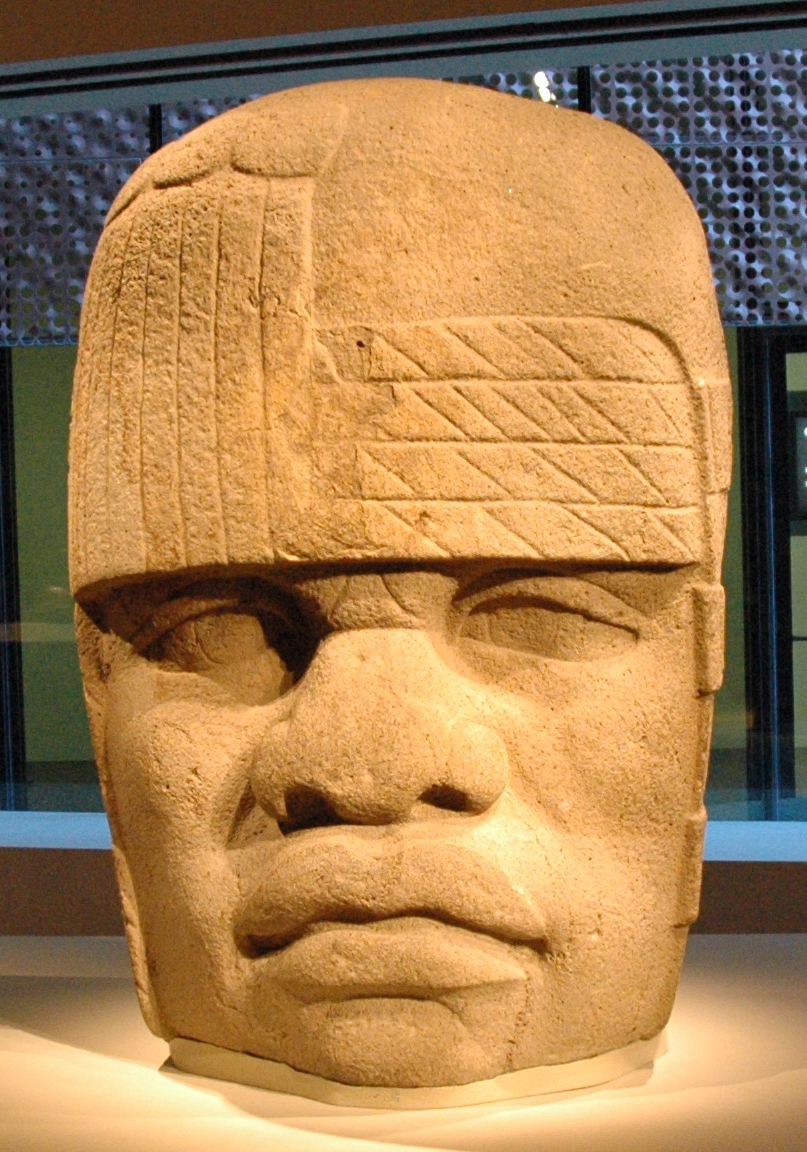
An Olmec colossal head (c. 1200–900 BCE), evidence of independent civilization in Mesoamerica — source
What actually makes a civilization? The scholarly toolkit and its quarrels
Social scientists have long tried to specify, rather than merely list, the traits that separate a civilization from other societies. The most influential taxonomy comes from the anthropologists Elman Service and Morton Fried, who arranged human societies into a rough sequence of political complexity: egalitarian hunter-gatherer bands; tribes or horticultural-pastoralist societies with a basic chief-and-commoner distinction; ranked chiefdoms with several inherited strata (king, noble, freeman, serf, slave); and finally states — the political core of civilization, with institutional government, bureaucracy, and codified coercion. Fried, a conflict theorist, saw the state as arising to manage and entrench inequality; Service, an integration theorist, saw it as arising to coordinate an increasingly complex society. That old disagreement — is the state a tool of exploitation or of organization? — has never been fully resolved and animates state-formation research to this day.
At the material base of all these models lies the question of the food surplus. The traditional surplus model holds that intensive cereal agriculture — with irrigation, fertilization, and crop rotation — produced storable grain surpluses, which freed some people from farming to become soldiers, priests, artisans, and rulers. Grain matters because it can be stored for years; you cannot bank a harvest of ripe tomatoes.
But a striking revisionist argument, developed by economists including Joram Mayshar, Omer Moav, and colleagues and published in the Journal of Political Economy, turns the surplus model on its head. Their claim is that roots and tubers were often more productive per acre than grain — yet precisely because they rot quickly and ripen unpredictably underground, they could not be easily seized, stored, or taxed. Cereals, by contrast, ripen all at once, above ground, on a schedule, making them perfectly appropriable. It was not surplus as such that bred states, but the taxability of the crop. Where highly productive tubers dominated, the very abundance became a "curse of plenty" that blocked the rise of a taxing elite. This appropriability thesis reframes the whole origin of the state around the incentives of predation and taxation rather than the benevolent accumulation of wealth — and it neatly explains why the earliest states cluster in cereal zones like Mesopotamia, Egypt, and China.
Two further caveats deflate any triumphalist reading of civilization as pure progress. First, food surplus and complex social organization sometimes precede full domestication: some Pacific Northwest peoples achieved dense, ranked, sedentary societies on salmon and other wild resources without farming, and the Natufians may have done something similar. Complexity is not the monopoly of farmers. Second, becoming "civilized" often made ordinary lives worse. Skeletal studies show that average male stature was actually greater in the European Middle Ages (roughly 500–1500 CE) than under the preceding Roman Empire or the succeeding early modern period, and nineteenth-century Plains Indians were typically taller than the "civilized" Americans and Europeans who displaced them. Since adult height tracks childhood nutrition and freedom from disease, these findings suggest that the crowding, epidemic disease, monotonous grain diets, and steep inequality of civilized life often shortened and sickened the bodies of the many even as they enriched the few.
Grand theories: the rise and fall of civilizations
The plural sense of "civilization" invited a distinctively grand kind of history: the attempt to discern a shared life-cycle across all civilizations. The German polymath Oswald Spengler, in The Decline of the West (1918–1922), argued that each high culture is an organism animated by a single "prime symbol," passing inexorably through youth, maturity, and decay. For Spengler, tellingly, Zivilisation was not the flowering of a culture but its wintry, exhausted end-state — "the most external and artificial states of which a species of developed humanity is capable." Civilization, in this pessimistic reading, is what a culture becomes when it has run out of creative vitality.
The British historian Arnold J. Toynbee built the most ambitious version of this project in his twelve-volume A Study of History (1934–1961), which identified and compared some twenty-one civilizations and five "arrested" ones. Toynbee's engine of history was "challenge and response": civilizations arise when a creative minority meets a hard environmental or social challenge with an inspired solution, and they decline when that minority loses its creative nerve — degenerating into a "dominant minority" that rules by force rather than inspiration — and fails the next challenge. He located the cause of collapse in moral and spiritual failure rather than in mere economics or environment, a view that later, more materialist historians largely rejected but never quite dispelled.
In the 1990s the political scientist Samuel P. Huntington repurposed the concept for geopolitics, defining a civilization as "the highest cultural grouping of people and the broadest level of cultural identity people have short of that which distinguishes humans from other species," and forecasting a post–Cold War "clash of civilizations" fought along religious-cultural fault lines. Critics — including many area specialists — charged that Huntington reified fluid, internally divided cultures into billiard-ball blocs. The historian David Wilkinson offered a suggestive counter-frame: he argued that the Mesopotamian and Egyptian civilizations fused, through trade and military-diplomatic contact, into a single "Central Civilization" around 1500 BCE, which then absorbed the Near East, Europe, and eventually — through colonialism — the entire globe. On Wilkinson's view a civilization can be culturally heterogeneous (like Central Civilization) or homogeneous (like Japan's), and what Huntington called a clash between civilizations is really friction between cultural spheres within one increasingly global civilization. These are not idle abstractions: they are competing answers to the question of whether "we" are many civilizations colliding or one civilization arguing with itself.
Networks, trade, and the systems view
A more recent school abandons the search for a civilizational essence and studies civilizations instead as complex systems — networks of cities bound together by economic, political, military, diplomatic, and cultural exchange. Systems theory has the virtue of guarding against the seductive but misleading organic analogies of Spengler and Toynbee (a civilization is not literally a body that ages and dies).
The systems view foregrounds a fact the older grand narratives underplayed: civilizations were interconnected almost from the start, and those connections operated at different scales. Trade networks, until the nineteenth century, typically stretched far wider than any political or cultural sphere. Guillermo Algaze's model of the "Uruk expansion" argues that even in the fourth millennium BCE, southern Mesopotamia's demand for timber, metal, and stone knit together a web reaching Egypt, Iran, and Afghanistan. Resin discovered in the Royal Cemetery at Ur may have travelled all the way from Mozambique. Two thousand years ago, the overland Silk Road across Central Asia and the maritime routes of the Indian Ocean linked the Roman, Parthian/Persian, Indian, and Chinese worlds in commerce long before those empires shared any diplomatic or cultural framework. Whether one dates true global integration to these ancient routes, to the medieval Crusades, or (the more conventional view) to early modern European colonialism, the systems perspective insists that no civilization was ever the sealed monad the grand theorists imagined.
Collapse and the research frontier
Ancient civilizations end as well as begin, and their collapses are now among the most active and contested areas of research. The classic case is the Late Bronze Age collapse around 1200–1150 BCE, when a densely interconnected system of eastern Mediterranean palace states — Mycenaean Greece, the Hittite Empire, and their trading partners — unravelled within a few decades. The causes remain fiercely debated: the mysterious "Sea Peoples" named in Egyptian inscriptions, prolonged drought now confirmed in pollen and isotope records, earthquakes, internal rebellion, and the very interconnectedness that turned local shocks into a cascading systemic failure. It is a sobering parallel for a globalized present, and the historian Eric Cline's phrase "1177 B.C." has become shorthand for the fragility of complex systems.
The image of collapse itself has a long cultural life. Percy Bysshe Shelley's sonnet Ozymandias (1818), inspired by a fragment of a colossal statue of Ramesses II then arriving at the British Museum, made the ruin of ancient greatness into a permanent Romantic emblem:
"'My name is Ozymandias, King of Kings; / Look on my Works, ye Mighty, and despair!' / Nothing beside remains."
Several open questions define the frontier. First, why did states arise at all — coercion and taxation (the appropriability thesis), voluntary coordination (Service), irrigation management (Karl Wittfogel's much-criticized "hydraulic" hypothesis), or something more contingent? Second, how uniform is the process? Recent work by David Graeber and David Wengrow (The Dawn of Everything, 2021) has forcefully attacked the whole linear ladder from band to state, pointing to seasonal cities, self-governing early metropolises without ruling elites (they argue for sites like Teotihuacan and the Ukrainian "mega-sites" of the Trypillia culture), and societies that consciously experimented with and rejected hierarchy — suggesting that inequality and the state were choices, not inevitabilities. Third, the undeciphered scripts — Indus above all, but also Linear A and Proto-Elamite — leave whole civilizations partly mute, and every proposed decipherment reopens the question of what writing even was for. Fourth, new scientific tools — ancient DNA, stable-isotope diet analysis, high-resolution paleoclimate reconstruction, LiDAR revealing lost cities beneath forest canopies in the Maya lowlands and the Amazon — are rewriting the map faster than the textbooks can keep up, and pushing the field toward collaboration between archaeology, genetics, and climate science.
Finally, there is the reflexive question with which we began. The category "ancient civilizations" was forged in the age of empire, and much of its early scholarship was entangled with colonial appropriation — from Napoleon's savants stripping Egypt to the looting that filled the great museums. Contemporary research increasingly asks not only what these societies were, but how our very way of naming and ranking them has shaped, and distorted, what we think we know. To study ancient civilizations rigorously today is to study both the past itself and the long shadow of the word we use to describe it.
Further exploration
- V. Gordon Childe, Man Makes Himself (1936) — the accessible classic that framed the Neolithic and Urban Revolutions; dated in detail but foundational for every later debate about how cities began.
- Arnold J. Toynbee, A Study of History (1934–1961; Somervell abridgment, 1946–1957) — the great twentieth-century attempt to compare civilizations; read the abridgment for the "challenge and response" thesis without the twelve volumes.
- Oswald Spengler, The Decline of the West (1918–1922) — the pessimistic, organicist counterpoint to Enlightenment optimism; important as much for its influence as for its arguments.
- Samuel P. Huntington, The Clash of Civilizations and the Remaking of World Order (1996) — the controversial book that put "civilizations" back at the center of geopolitics; best read critically alongside its many rebuttals.
- David Graeber and David Wengrow, The Dawn of Everything: A New History of Humanity (2021) — a bracing assault on the linear band-to-state story, drawing on the latest archaeology to argue that early societies were more experimental and less hierarchical than assumed.
- Eric H. Cline, 1177 B.C.: The Year Civilization Collapsed (2014) — a vivid, evidence-driven account of the Late Bronze Age collapse and a meditation on the fragility of interconnected systems.
- Andrew George (trans.), The Epic of Gilgamesh (Penguin, 1999) — the finest modern rendering of the oldest great poem, offering an unmatched window into how Mesopotamians imagined kingship, death, and the city.
- The Code of Hammurabi (c. 1754 BCE), on its basalt stele in the Louvre — a primary legal document you can read in translation; its graded penalties expose the stratified logic of an ancient state.
- The Standard of Ur, Rosetta Stone, and Narmer Palette (British Museum and Egyptian Museum, Cairo) — three artifacts that between them show a stratified Sumerian society, the key to reading Egyptian, and the mythic moment of Egyptian unification.