What is History?
History is the study of the human past through the evidence it left behind — above all written records, but also objects, bones, landscapes, and stories — and the disciplined interpretation of that evidence by scholars who are themselves shaped by their own time.
The question "What is History?" sounds naïve until you try to answer it. It is at once a question about a subject matter — what portion of the past counts as "historical"? — and a question about a practice — how do historians know anything, and can they ever tell the truth about the dead? These two questions are joined at the root. Where you draw the boundary of history depends on what you accept as evidence, and what you accept as evidence depends on what you think the historian is doing. This chapter works through both: first the long, deep problem of where "history" begins and what to do with the tens of thousands of years that precede it, and then the craft and epistemology of the discipline, culminating in the twentieth century's most influential meditation on the subject, E. H. Carr's What Is History? of 1961.
The narrow doorway of writing
By the oldest and most literal definition, history begins with writing. The Greek word historia meant "inquiry," and for millennia the inquiry that mattered was into events preserved in texts. On this reckoning, recorded history is astonishingly short. Writing was invented in southern Mesopotamia — Sumer — around 3200 BCE, when scribes at cities such as Uruk began pressing wedge-shaped marks into wet clay with a cut reed. This is cuneiform, from the Latin cuneus, "wedge." The earliest tablets are not epics or laws but accounts: tallies of barley, sheep, jars of beer, the receipts and ration-lists of a temple economy. Writing was born as bookkeeping, and only later learned to carry myth, chronicle, and prayer.

An early cuneiform administrative tablet from Sumer, where writing — and with it "recorded history" — began around 3200 BCE — source
If history proper opens with those clay tablets, then the entire span of the written past is roughly five thousand years — call it six thousand if we generously include the borderline of proto-writing and the near-simultaneous emergence of Egyptian hieroglyphs. Set that against the age of our species. Anatomically modern Homo sapiens has existed for something on the order of three hundred thousand years, and the genus Homo for more than two million. On this scale, the literate past is a thin bright band at the very top of a very deep column. The overwhelming majority of the human story unfolded before anyone wrote a word.
This is the fundamental scandal that the question "What is History?" must confront. If history is only what is written, then history has almost nothing to say about the people who painted the caves of Ice Age Europe, who first tamed wheat and goats, who walked out of Africa and populated every habitable continent. Those people were as fully human as any Sumerian scribe. To exile them from "history" on the technicality that they left no documents is either an honest confession of the limits of one method or an arbitrary act of disciplinary border-drawing — and generations of scholars have argued about which.
Prehistory: the long past without documents
The conventional term for everything before writing is prehistory. The word itself encodes the priority of texts: the "pre-" marks this vast era as a mere prologue, the time before the real show began. It is worth being suspicious of that framing, because the volume of human experience it consigns to a prefix is almost unimaginable.
Consider the Paleolithic — the Old Stone Age — which runs from the first stone tools more than three million years ago down to the end of the last Ice Age around twelve thousand years ago. This is the deepest of what the French Annales historian Fernand Braudel called the longue durée, the long duration of slow, near-glacial change against which the noise of events (a battle, a coronation, a treaty) is a brief flicker. For the Paleolithic there is no histoire événementielle, no history of events in the ordinary sense, because there are no dated happenings preserved by witnesses. There is only the slow accumulation of technique, anatomy, and habitat, read off from stone, bone, and sediment.
And yet something momentous happened within that duration. Somewhere in the Middle and Later Stone Age — the debate over the exact tempo is live — our ancestors began to behave in ways we recognize as fully, unmistakably modern. Archaeologists call this behavioral modernity: the appearance of symbolic thought, art, personal ornament, long-distance exchange, sophisticated tools, ritual burial, and probably fully syntactic language. The evidence is scattered and eloquent. Pierced shell beads and engraved ochre from Blombos Cave in South Africa run back roughly seventy to a hundred thousand years. And then, in the caves of Ice Age Europe, the record explodes into imagery.
The painted caves are the closest thing prehistory has to a masterpiece and a primary source at once. At Chauvet in southern France, charcoal drawings of lions, rhinoceroses, and horses date to around thirty-six thousand years ago; at Lascaux, the great hall of bulls dates to roughly seventeen thousand years ago; the hand stencils and animals of El Castillo in Spain reach back beyond forty thousand years. These are not doodles. They are composed, they use the contours of the rock for modeling, they were made deep underground by torchlight, and they were revisited over centuries. They tell us that people with minds like ours were thinking about animals, death, fertility, and the unseen long before any king dictated an inscription.
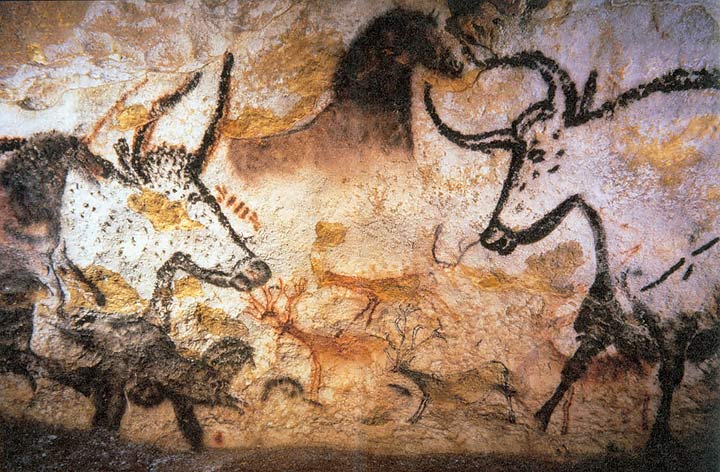
The Hall of the Bulls at Lascaux, painted roughly seventeen thousand years ago — a "primary source" from tens of thousands of years before writing — source
How do we know any of this without documents? By an arsenal of evidence that has transformed prehistory from guesswork into a rigorous science, and that increasingly bleeds into the toolkit of historians proper.
Artifacts and stratigraphy. The oldest method reads objects in the ground — tools, pottery, hearths, bones — layer by layer, on the principle that deeper is older. Typology (classifying the changing forms of tools and pots) and superposition let archaeologists build relative sequences; radiocarbon dating, developed by Willard Libby in the late 1940s, and later refinements such as potassium–argon and thermoluminescence dating, pinned those sequences to calendar years.
Genetics. Since the 1990s, and explosively since the sequencing of ancient DNA, genetics has become a historical archive in its own right. The mitochondrial and Y-chromosome lineages of living people, and now the genomes recovered from actual ancient bones, allow scholars to reconstruct the great migrations out of Africa — the dispersal of Homo sapiens across Eurasia beginning roughly sixty to seventy thousand years ago, the interbreeding with Neanderthals and Denisovans that left traces in nearly every non-African genome today, and the later peopling of the Americas. Svante Pääbo, who sequenced the Neanderthal genome and won the 2022 Nobel Prize for it, effectively read a chapter of human history that no text and few bones could ever record.
Oral tradition. Where writing fails, memory sometimes carries. Genealogies, myths, and songs transmitted across generations preserve real information — the eruption of a volcano, the arrival of a founding ancestor, a change in coastline — sometimes with startling fidelity across thousands of years. The oral traditions of Aboriginal Australian peoples, some of which appear to encode sea-level rise at the end of the Ice Age, are the most dramatic case. Oral tradition is treacherous evidence, easily reshaped by the present, but it is evidence, and its rehabilitation was a major achievement of twentieth-century historians of Africa such as Jan Vansina.
Climate proxies. Finally, the environment writes its own record. Ice cores from Greenland and Antarctica, layered like tree rings, preserve trapped air bubbles and isotope ratios that reconstruct ancient temperature and atmospheric composition; deep-sea sediment cores, pollen sequences from lake beds, and speleothems (cave formations) trace the advance and retreat of glaciers and the shifting of monsoons. This is how we know the climatic stage on which human history was performed — and how we can connect a warming, stabilizing climate after about twelve thousand years ago to the single most consequential change in the human career.
The Neolithic revolution
That change is the Neolithic revolution — the transition, beginning around ten to twelve thousand years ago in several parts of the world independently, from foraging to farming. The term was coined by the Australian-born archaeologist V. Gordon Childe in the 1920s and 1930s. In the Fertile Crescent, people began cultivating wild wheat and barley and herding sheep, goats, and cattle; in China, millet and rice; in Mesoamerica, maize and squash; in the Andes and New Guinea, still other crops. Domestication was not a single eureka but a slow, often reluctant entanglement of humans with the plants and animals they came to depend on.
Its consequences made everything else in this chapter possible. Farming tied people to place, allowed food surpluses, and let populations grow. Surpluses supported people who did not farm — priests, chiefs, soldiers, and, crucially, scribes. Sedentary villages grew into towns and then, in Mesopotamia, into the first cities. Property, hierarchy, taxation, and organized religion followed. And out of the need to record who owed what to the temple came, at last, writing. The Neolithic revolution is therefore the hinge on which the whole conventional scheme turns: it is the long fuse that ends in the cuneiform tablet, and thus in the beginning of "history" as textualists define it.
Seen this way, the history/prehistory divide is not a natural fault line in the human past. It is a threshold defined entirely by a single technology of record-keeping — and one that fell at wildly different dates in different regions. Sub-Saharan Africa, Oceania, and much of the Americas remained "prehistoric" by this definition into the second millennium CE or later, not because their peoples lived shallower lives but because they did not adopt writing. The divide has an uncomfortable colonial residue: it once flattered literate, usually European, societies as the possessors of "history" and demoted everyone else to a static, ethnographic "prehistory." Much of the intellectual energy of the last half-century has gone into dismantling that flattery.
Deep history and big history
Two movements have pushed hardest against the tyranny of the written threshold.
Deep history argues that the artificial wall between prehistory and history should simply be removed, and that historians should treat the whole human career — Paleolithic, Neolithic, and literate — as a single continuous story amenable to historical analysis. Its manifesto is Daniel Lord Smail's On Deep History and the Brain (2008), which contends that the conventional origin of history in Mesopotamia is a secularized relic of the biblical account of human beginnings in Eden, and that the tools of genetics, neuroscience, and archaeology now let historians reach back before writing without leaving history for some other discipline. Deep historians want to naturalize human history — to fold it back into the evolutionary and ecological story of the species — and to make the deep past a legitimate object of the historian's, not just the archaeologist's, attention.
Big history goes further still, expanding the frame beyond humanity altogether. Associated above all with the historian David Christian and his synthesis Maps of Time: An Introduction to Big History (2004), it sets human history within a single grand narrative that begins with the Big Bang some thirteen point eight billion years ago and proceeds through the formation of stars and galaxies, the origin of the Earth and of life, and the emergence of humanity, to the present and beyond. Big history looks for common patterns — rising complexity, the flow of energy, thresholds of new possibility — across cosmic, geological, biological, and human scales. Its critics charge that it dilutes the specificity of the human past into a metaphysics of "complexity"; its defenders answer that only such a frame does justice to how tiny and recent the written record really is, and how deeply human life is embedded in nature.
Both movements are, at bottom, answers to the scandal with which we began: they refuse to let the accident of writing decide what counts as history. But they do not dissolve the harder question, which is the question of method. For once you leave the terrain of documents, you rely on inference from mute evidence; and once you return to documents, you face the fact that texts are made by biased, situated, fallible human beings. This is the second great front of "What is History?" — the historian's craft.
The historian's craft: sources, evidence, interpretation
Working historians distinguish primary sources — evidence produced within the period under study: a charter, a letter, a court record, a coin, a photograph, a skeleton — from secondary sources, the later reconstructions and interpretations built out of primary material. The primary source is the historian's contact with the past, but that contact is never direct or innocent. A tax roll records what a scribe chose, or was compelled, to record; a chronicle flatters its patron; a diary confides selectively; a treaty conceals as much as it states. The historian's core skill is source criticism: establishing that a document is what it claims to be (external criticism), and then weighing what it can and cannot tell us given who made it, when, why, and for whom (internal criticism). Evidence, in other words, is never simply "given"; it is interrogated, and the answers depend heavily on the questions.
This is why bias and perspective are not incidental defects to be scrubbed away but structural features of the whole enterprise. The maker of every source had interests, blind spots, and a point of view; so does every historian. A source that is worthless as a neutral report of the facts may be priceless as a window onto the mentality of the person who made it — a piece of propaganda tells us little about the battle and everything about the propagandist. Learning to read sources against the grain, to extract from a biased witness the very thing the witness did not mean to reveal, is the historian's most delicate art.
The founding tension of the discipline is already present at its birth in the fifth century BCE, in the persons of the two "fathers" of Greek history. Herodotus of Halicarnassus, writing about the Persian Wars around 430 BCE, opens his Histories by declaring his purpose: to preserve the memory of great deeds and to inquire into their causes, "so that human achievements may not be forgotten in time, and great and marvellous deeds… may not be without their glory." Herodotus was a gatherer of historia in the original sense — an inquirer who travelled, listened, and recorded competing versions, myths, wonders, and hearsay alongside eyewitness testimony, often flagging his own doubts. He is capacious, digressive, and skeptical about his own material.

A Roman copy of a Greek bust of Herodotus, the fifth-century BCE inquirer whose Histories gave the discipline its name — source
Thucydides, writing his account of the Peloponnesian War a generation later, deliberately narrowed and hardened the genre. He disdained the "romance" of storytellers, restricted himself to near-contemporary events he could check, subjected testimony to critical scrutiny, and famously declared his work "a possession for all time" rather than "a prize composition to be heard for the moment." Where Herodotus embraces the marvellous, Thucydides prizes accuracy, causation, and the durable regularities of political behavior. Between them, these two writers stake out the poles between which the discipline has oscillated ever since: history as capacious inquiry into human variety, and history as rigorous, evidence-bound reconstruction.
Ranke and the dream of the archive
For more than two millennia after the Greeks, historical writing remained largely a branch of literature, rhetoric, or theology — a vehicle for moral instruction, dynastic glory, or providential design. The transformation of history into a professional academic discipline with its own methods is the achievement above all of nineteenth-century Germany, and above all of Leopold von Ranke (1795–1886).
Ranke insisted that the historian's task was to show the past wie es eigentlich gewesen — "as it actually was," or "essentially" was. He built history on the systematic, critical exploitation of primary archival documents, teaching his students in the seminar to trace every claim back to its most reliable source and to distinguish the trustworthy from the derivative. Under his influence, and that of the burgeoning state archives opened to scholars across nineteenth-century Europe, history became a discipline of the document, professionalized in universities, footnoted, and armed with the philological rigor Ranke had learned from classical scholarship. The Rankean ideal — that if the historian is honest and thorough enough, and lets the sources speak, an objective account of the past can be recovered — dominated the profession into the twentieth century and remains, for many working historians, the implicit standard even now.
But the Rankean dream contains a latent contradiction. The archives are themselves the residue of power: they preserve what states, churches, and the propertied wanted preserved, and they fall silent about the illiterate majority. And the "objective" historian who reads them is a person of a particular nation, class, gender, and era, asking particular questions. The twentieth century, having watched two world wars and the collapse of the comfortable certainties of the Victorian age, was ready to challenge the idea that history could ever be a mirror of the past. That challenge found its most famous English-language expression in a slim book drawn from a series of lectures.
E. H. Carr and What Is History?
Edward Hallett Carr (1892–1982) was a British diplomat turned historian, best known for a monumental multi-volume History of Soviet Russia. In January and February 1961 he delivered the George Macaulay Trevelyan Lectures at the University of Cambridge, and later that year published them as What Is History? Conceived as a broad introduction to the theory of history, the book's very accessibility made it one of the foundational texts of historiography — a book, in the words of the critic Keith Windschuttle (himself hostile to Carr), that is among the most influential ever written on the subject, and which very few historians writing in English since the 1960s have failed to read. The historian Richard J. Evans went so far as to say it caused a revolution in British historiography in the decade of its publication.
The book runs through six chapters: (1) "The Historian and His Facts," (2) "Society and the Individual," (3) "History, Science and Morality," (4) "Causation in History," (5) "History as Progress," and (6) "The Widening Horizon." Its most quoted move comes in the first chapter, where Carr demolishes the Rankean faith in the self-sufficient fact. There is, he argued, a crucial difference between the mere "facts of the past" and the "historical facts" that historians actually work with. Countless things happened; only a tiny, pre-selected fraction survive in the sources, and of those the historian elevates a smaller fraction still into the load-bearing "facts" of a historical account. A fact, in his image, is like a sack — it will not stand up until you put something in it. The philosopher W. H. Walsh made the point crisply in a 1963 review: it is not a "fact of history" that Walsh had toast for breakfast that morning, however true it may be, because no historian will ever build anything on it.
From this Carr drew a lesson about the inseparability of the historian from the history. "Before you study the history," he advised, "study the historian… Before you study the historian, study his historical and social environment." History was not a heap of objective facts waiting to be recovered but "a continuous process of interaction between the historian and his facts, an unending dialogue between the present and the past." Walsh, reviewing the book, agreed with Carr on precisely this: historians do not stand above the stream of history but are products of their own place and time, and it is their situation that governs which "facts of the past" they promote into "facts of history."

E. H. Carr, whose 1961 lectures became What Is History?, the most influential English-language book on historiography — source
If Carr had stopped there, he would simply have been an eloquent anti-positivist. But he pressed on into more contentious territory, and it is this that made the book a battlefield. Two moves in particular provoked his critics.
First, his relativism about facts seemed, to some, to slide toward the view that history is whatever the historian makes of it — that there is no firm ground beneath the interpretation. Carr did not, in fact, embrace pure subjectivity, but his rhetoric invited the charge.
Second, and more sharply, Carr rejected contingency — the role of accident and the "might-have-been" — as a serious factor in historical explanation. He was impatient with counterfactual speculation, dismissing the alternatives that did not happen as a kind of parlour game unworthy of the professional. History, for Carr, moved with a broadly rational, forward direction; his fifth chapter, "History as Progress," made that faith explicit.
The Carr–Elton debate and the argument over objectivity
The most famous rebuttal came from the Tudor historian Geoffrey Elton in The Practice of History (1967). Elton attacked Carr's distinction between the "facts of the past" and the "historical facts" as "whimsical," and worse, as reflecting "an extraordinarily arrogant attitude both to the past and to the place of the historian studying it." For Elton, the past had an integrity of its own that the historian was obliged to respect and reconstruct, not to constitute through present-minded selection. Yet Elton praised Carr for one thing — his rejection of accidents in history — while turning even that praise into a critique: he charged that Carr's philosophy of history was really a secularized version of the medieval Christian vision of the past as the unfolding of God's master plan, with "Progress" simply installed in the vacant throne of God. It was a devastating line, because it accused the professed rationalist and relativist of smuggling in a hidden theology of inevitability.
The other principal assault came from Hugh Trevor-Roper, who fastened precisely on Carr's dismissal of the "might-have-beens of history." To refuse to consider alternative outcomes, Trevor-Roper argued, betrayed a fundamental lack of interest in causation itself. Weighing possible outcomes was not a frivolous parlour-game but an essential discipline: only by looking at all the paths not taken, and at all sides of a conflict, could a historian grasp why events fell out as they did. Carr's method — understanding only the winners and treating the actual outcome as the sole possible one — produced, in Trevor-Roper's blunt verdict, "bad historians."
Not all responses were hostile. Writing in the German journal Historische Zeitschrift in 1963, Andreas Hillgruber welcomed Carr's geistvoll-ironischer — his "ironically spirited" — skewering of conservative, liberal, and positivist historians alike, recognizing in the book a bracing corrective to complacent schools of historical writing. And in the long run Carr's central insight proved indispensable even to those who rejected his politics: the recognition that the historian is not a transparent recording instrument but a situated interpreter has become common ground across the profession.
Carr was revising What Is History? for a second edition when he died in 1982. The reworked edition appeared posthumously in 1986 with a preface by his collaborator R. W. (Bob) Davies, and was reprinted in 2001 with a substantial critical introduction by Richard J. Evans and additional material — Davies's introductory note, Carr's own draft preface to the second edition, and Davies's presentation of notes from Carr's files. The first edition itself had gone through repeated reprintings — in 1961, twice in 1962, and again in 1969, 1972, 1977, and 1982 — a testament to its grip on the teaching of the subject.
The open questions
The two halves of this chapter turn out to be one problem. The debate over where history "begins" and the debate over whether history can be objective are both about the same thing: the relationship between the fragmentary, biased traces the past has left and the present-day mind that reads them. When Smail and Christian dissolve the boundary of writing, they are enlarging the range of evidence historians will admit — genes, sediments, tools, songs — and thereby transforming what counts as a source. When Carr insists that facts do not speak for themselves, he is making the same point at the level of texts: that evidence is inert until a questioner activates it.
Several questions remain genuinely open at the research frontier. Can the methods of deep history — neuroscience, evolutionary theory, ancient DNA — be integrated with the interpretive, document-based craft of conventional history without either colonizing the other? How far can oral tradition and archaeological inference bear the explanatory weight that historians once placed on texts alone? Is the recovery of ordinary lives — the illiterate, the enslaved, the colonized, women — possible from archives that were built to ignore them, or does it require the very expansion of "history" beyond the document that deep history proposes? And beneath it all sits Carr's unresolved question, the one that gives his book its enduring bite: if every historian is a product of a time and place, and every source the residue of somebody's interest, is objective history possible at all — or is the honest historian's goal not a view from nowhere, but a disciplined, self-aware, endlessly revisable dialogue between the living and the dead? The discipline has largely settled on the second answer. That it can hold that modest, rigorous position without collapsing into "anything goes" is the hardest and most important thing history knows about itself.
Further exploration
- E. H. Carr, What Is History? (1961; 2nd ed. 1986; with Evans's introduction, 2001). The indispensable starting point — read it first, then read its critics. Evans's introduction is the best short guide to the controversy.
- Geoffrey Elton, The Practice of History (1967). The great counterblast: a defense of the archive, the document, and the autonomy of the past against Carr's present-mindedness.
- Herodotus, The Histories (c. 430 BCE), trans. Robin Waterfield or Tom Holland. The founding act of the discipline; digressive, credulous, skeptical, and endlessly humane.
- Thucydides, History of the Peloponnesian War (late fifth century BCE), trans. Rex Warner. The counter-model of austere, evidence-driven, causally minded history — "a possession for all time."
- Marc Bloch, The Historian's Craft (written 1941–43, published 1949). A luminous meditation on evidence and method by a founder of the Annales school, written in the Resistance before his execution by the Gestapo.
- David Christian, Maps of Time: An Introduction to Big History (2004). The most ambitious attempt to set human history within the whole story of the cosmos.
- Daniel Lord Smail, On Deep History and the Brain (2008). The manifesto for erasing the wall between prehistory and history and reclaiming the deep past for historians.
- Svante Pääbo, Neanderthal Man: In Search of Lost Genomes (2014). A first-person account of how ancient DNA opened a new archive of the human past that no text could reach.
- Richard J. Evans, In Defence of History (1997). A measured modern reckoning with the Carr–Elton debate and the postmodern challenge to historical truth.
- The painted caves of Lascaux and Chauvet, and the engraved ochre and shell beads of Blombos Cave — primary sources tens of thousands of years older than any document, and proof that the deep past has voices, if we learn to hear them.